You already know medicine is a long road. What you’re really trying to figure out, probably at eleven at night with a browser tab open, is exactly how long the residency for general surgery actually takes, and whether the number you keep seeing online is even accurate anymore. Here’s the direct answer, plus the parts nobody tells you until you’re already three years deep.
A quick overview, before we get into it:
- How many years is residency for general surgery in Canada? Five years, accredited by the Royal College of Physicians and Surgeons of Canada. The residency for general surgery follows a structured, progressive curriculum rather than five interchangeable years of the same experience.
- Does that include a foundational period? Yes. The first two years are Surgical Foundations, shared training that all surgical residents complete before specializing further.
- Is general surgery residency the same length in the US? Close. US general surgery residency is also typically five years, accredited by the ACGME instead of the Royal College.
- Do I need more training after those five years? Only if you’re pursuing a subspecialty. Fields like colorectal, vascular, or surgical oncology usually add one to two more years of fellowship on top of the base residency for general surgery.
Now let’s actually unpack what those five years look like, because “five years” sounds simple until you’re the one living through it.
What the Residency for General Surgery Actually Looks Like, Year by Year
The residency for general surgery in Canada runs five years, and it is not five identical years stacked on top of each other. The first two years fall under Surgical Foundations, a shared curriculum across surgical specialties that covers the fundamentals every surgeon needs, from basic operative skills to trauma management to critical care exposure. During this stretch, you’re a junior resident, learning fast, absorbing constant feedback, and building the foundation the rest of your training rests on.
Years three through five shift the weight onto your shoulders. You’ll take on graduated responsibility, moving from assisting to operating with increasing independence, and by your final year, chief residents are expected to run a surgical unit under staff supervision, coordinate care, and mentor the junior residents coming up behind them. That fifth year of the residency for general surgery is where a lot of the real transformation happens. You walk in as a senior trainee and walk out functioning close to the level of a new consultant.
It’s worth being honest here, because a lot of prospective applicants underestimate this part: the residency for general surgery is one of the more demanding paths in medicine, not because the material is harder than other specialties, but because the hours, the physical stamina required, and the pace of decision-making compound over five straight years with very little room to coast.
Comparing General Surgery to Other Surgical Residencies
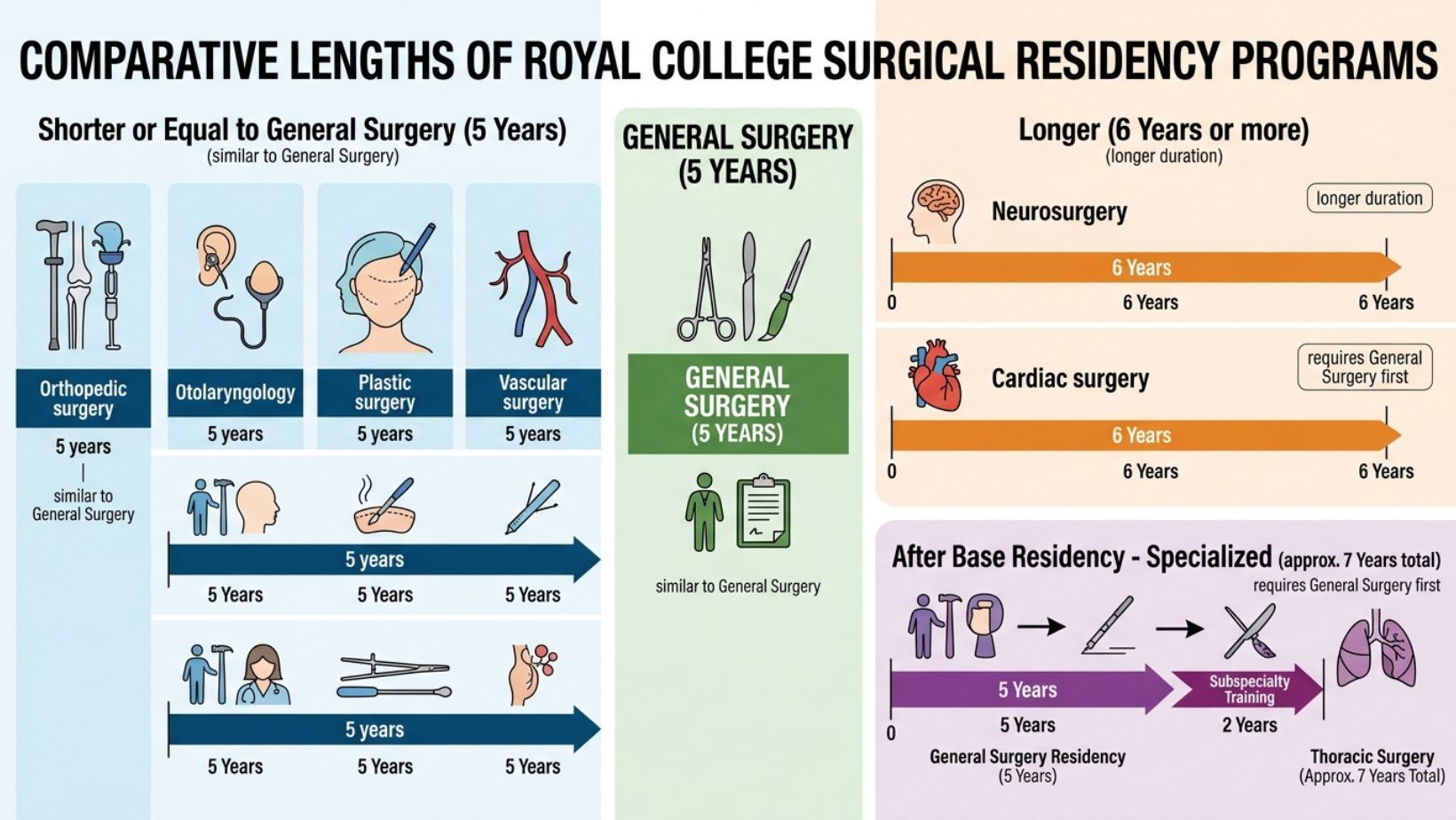
Context helps here, because five years can sound long in isolation but it’s actually mid-pack once you compare the residency for general surgery to other Royal College surgical programs.
- Shorter or equal: Orthopedic surgery, otolaryngology, plastic surgery, and vascular surgery all run five years, similar to general surgery.
- Longer: Neurosurgery and cardiac surgery both extend to six years, sometimes longer depending on the training pathway a program follows.
- After the base residency: Thoracic surgery typically requires the five-year residency for general surgery first, followed by two more years of subspecialty training, bringing the total closer to seven years for some surgeons.
So when someone tells you general surgery is “one of the shorter surgical paths,” that’s technically true, but it’s a low bar. You’re still committing to half a decade of intense, structured training before you’re eligible to sit the Royal College certification exam, and the residency for general surgery still asks more of your twenties or early thirties than most careers outside medicine ever will.
What Happens After Those Five Years
Finishing the residency for general surgery doesn’t lock you into general practice forever. Many graduates subspecialize, and it’s worth knowing what that adds to your timeline before you commit. Colorectal surgery, surgical oncology, hepatobiliary and pancreatic surgery, minimally invasive surgery, and trauma and acute care surgery are common fellowship routes, each typically adding one to two years on top of the base five.
That means a surgeon pursuing a competitive fellowship could be looking at six to seven years of total postgraduate training, on top of the four years of medical school before residency even started. It’s not a reason to avoid the path, but it’s a number worth knowing honestly rather than discovering it mid-training. Plenty of surgeons practice broad-scope general surgery straight out of their five-year residency for general surgery and never pursue a fellowship, a completely legitimate route, especially for those aiming at community hospital practice. Either way, knowing this upfront helps you plan around a realistic version of the residency for general surgery rather than the version you assumed from a quick search.
Why the Length of a Residency for General Surgery Matters When You’re Choosing a Path

If you’re still a pre-med student weighing specialties years before you’ll even apply to residency, this might feel like a distant concern. It isn’t. The length of the residency for general surgery directly affects your total years of deferred income, the age you’ll be when you finally start practicing independently, and how much flexibility you’ll have for research, family planning, or subspecialty exploration along the way.
For those already deep into medical school and starting to think seriously about CaRMS, the calculation gets more concrete. Five years of medical residency is a five-year commitment to a specific hospital system, a specific city in many cases, and a training culture you’ll need to thrive inside, not just tolerate. That’s exactly why so many applicants treat the decision to pursue general surgery as seriously as they treat their MCAT prep or their personal statement, because the residency for general surgery isn’t just a line on a CV, it’s half a decade of your twenties or thirties.
What This Means for Where You Are Right Now
If you’re a resident currently in the middle of a demanding rotation, the honest truth is that the structure of the residency for general surgery is designed to feel relentless in years three and four specifically, because that’s when the responsibility curve is steepest. Knowing that in advance doesn’t make the workload lighter, but it does make it less disorienting when it hits, and it’s a pattern that holds true across nearly every general surgery program in the country, not just yours. You are not behind. You are exactly where a chief resident before you also stood.
And if you’re still applying, whether you’re early in your journey or a medical student preparing your CaRMS rank list, understanding the real shape of the residency for general surgery, not just the headline number, should shape how you talk about it in interviews and personal letters. Programs can tell the difference between an applicant who picked general surgery because it sounded impressive and one who actually understands what five demanding years of training requires. Many applicants work with medical consultants specifically to make sure that distinction comes through clearly on paper and in the room.
Ready to Build a Realistic Plan for General Surgery?
Whether you’re mapping out your specialty choices early or already deep into CaRMS prep, understanding what the residency for general surgery demands, year by year, is the difference between a plan built on assumptions and one built on facts. MDconsultants Prep works with applicants at every stage, from early specialty planning through residency interview prep, to build a strategy around the specialty and timeline that actually fits your goals.