There is no single hardest year of residency for everyone. Most residents describe the first year (PGY1) as the steepest learning curve, because you move from student to the doctor making decisions. But the data tells a more interesting story: burnout and job stress often peak later, in PGY2 or PGY3, depending on the specialty, the program and the workload. In other words, the hardest year is the one where your responsibilities grow faster than your comfort.
Sounds like a cliffhanger, right? Here are the questions people keep typing into Google, and we’re answering every one:
- What is the hardest year of residency?
- Is the first year of residency the hardest?
- Is PGY2 harder than PGY1?
- Which year of residency has the most burnout?
- Does residency get easier?
The Short Answer: It Depends, But There’s a Pattern
Here’s the pattern most residents recognize. PGY1 is hard because everything is new. PGY2 is hard because the load and the expectations jump. PGY3 can be hard because fatigue builds and the finish line still feels far away. Nobody gets a free year, but each year is hard in a different way.
One caution before we go further: much of the best data comes from the United States, and Canadian surveys are smaller and vary by specialty. So treat the numbers below as clues, not a verdict on your own residency.
PGY1: The Steepest Learning Curve

On day one, you stop being the person who watches decisions and become the person who makes them. Residents describe the first year as drinking from a fire hose, and that’s not an exaggeration. Your level of responsibility soars, even though you’re still closely supervised by senior residents and attending physicians.
The small things add up fast: placing your first order, learning a new electronic medical record, running a team list and managing your time on an unfamiliar ward. One Alberta resident reflecting on the end of PGY1 described exactly these firsts, and how quickly they became routine.
Why it feels brutal: transition shock, steep learning, unfamiliar systems and the fear of making a mistake.
The upside: it’s usually your greatest growth curve, and you’re supervised more closely than at any later stage.
PGY2: When the Responsibility Hits
Here’s the plot twist. You’d think the second year would feel easier, and in some ways it does. But new data suggests it can be harder on your wellbeing.
In American Medical Association survey data covering more than 1,600 residents, the burnout rate among second year residents was 47 percent. That was 10 points higher than the PGY1 rate and 4 points higher than the next highest year, PGY3 at 43 percent. PGY2 residents also reported the highest job stress, at 49 percent.
Why? You often carry a bigger patient load, and you’re now supervising junior residents while still getting comfortable yourself. One resident described going from a cap of 10 patients to 15 almost overnight, while also answering questions from interns every few minutes.
Canadian data points the same way in some fields. In a national survey of Canadian psychiatry residents, burnout was reported more often by PGY2 residents than by those in other years.
PGY3: The Fatigue Year
By the third year, the novelty has worn off, but the finish line is still far away. Canadian surveys show the strain here too. In a national survey of Canadian paediatric residents, 42 percent met the criteria for burnout, and third year residents were at the highest risk.
In Canadian emergency medicine residents, 62 percent met the threshold for burnout overall. PGY3 had the highest rate at 83.3 percent, but the differences between years were not statistically significant, and the survey had a 30 percent response rate. In plain terms: burnout was high across all years.
Which Year Is Hardest? A Side by Side Look
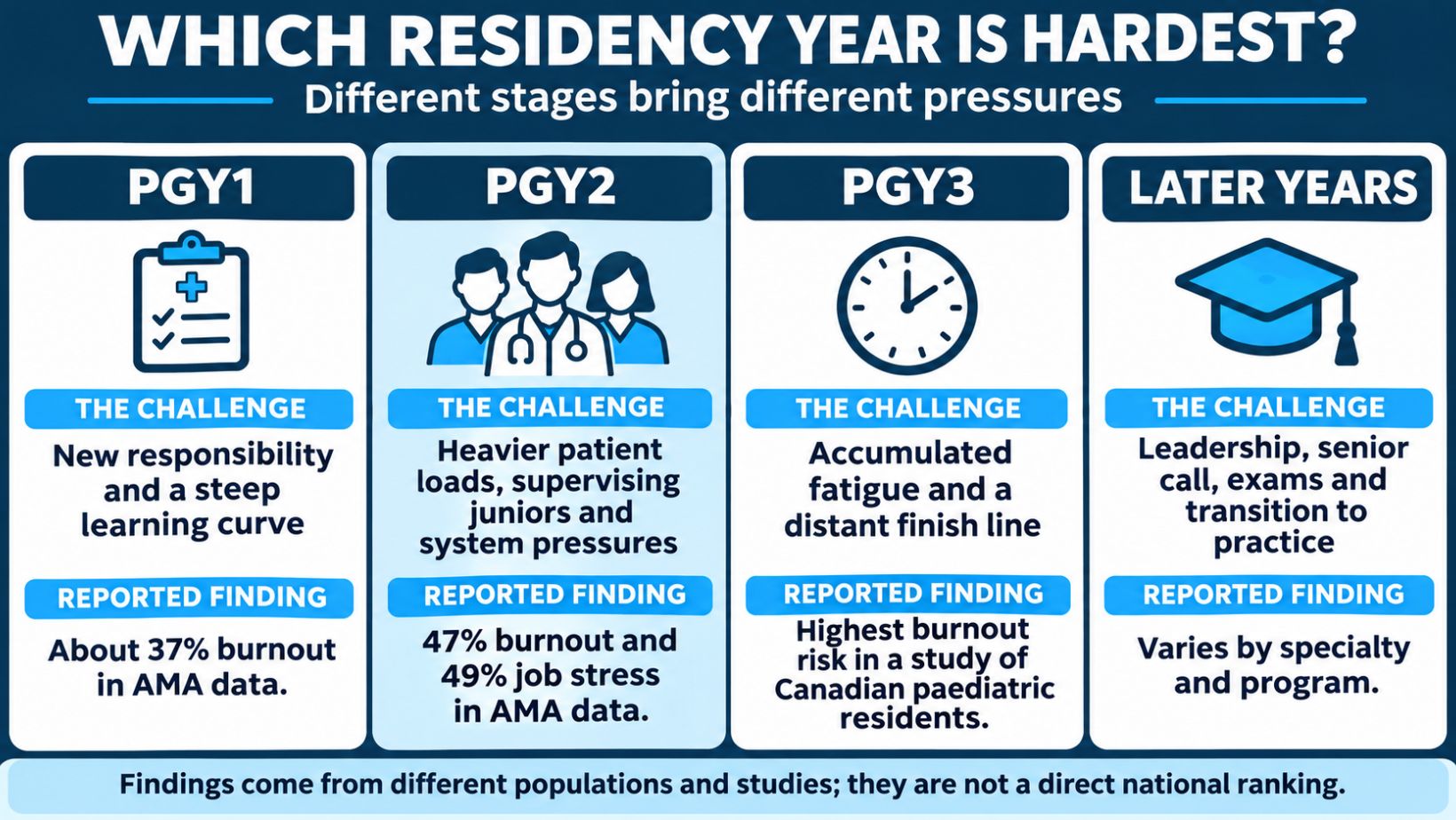
| Year | Why it’s hard | What the data suggests |
| PGY1 | Transition to real responsibility, steep learning curve | Burnout of about 37 percent in AMA data, lower than later years |
| PGY2 | Bigger patient loads, supervising juniors, more exposure to system problems | Highest burnout (47 percent) and job stress (49 percent) in AMA data |
| PGY3 | Accumulated fatigue, distance from the finish line | Highest burnout risk in Canadian paediatric residents |
| Later years | Leadership, senior call, exams and transition to practice | Varies widely by specialty and program |
Why There’s No Single Answer
Because residency isn’t one experience. A two year family medicine residency in Canada compresses the transitions into a much shorter window than a five year specialty program. Call schedules, specialty culture, program support and even the hospital’s electronic record system change how a year feels.
The stressors aren’t only personal, either. When AMA surveyed residents, the top stressors were a lack of adequate physicians and support staff at 24 percent, too many administrative tasks at 21 percent, no control over schedule at 16 percent, an ineffective electronic record system at 14 percent and educational stress at 12 percent. AMA’s takeaway was that many of these drivers sit at the system level, not in the individual resident.
That’s consistent with a national survey by Resident Doctors of Canada, where 51.9 percent of respondents reported symptoms of burnout. That survey had a low response rate of 8.3 percent, so read it with care, but the message is clear: pressure is widespread.
How to Get Through the Hard Parts
Whatever year you’re in, a few habits help:
- Expect the transitions. The first month of PGY1, your first night float and your first senior role are known pressure points.
- Find mentors early. Ask a senior resident how they handled the same stage.
- Protect the basics. Sleep, food and movement are not luxuries during a heavy rotation.
- Use your program’s supports. Wellness resources exist, so use them before things pile up.
- Speak up about the system. If workflow and workload are the problem, tell your program leaders.
- Ask for help early. If stress starts affecting your sleep, mood or work, talk with a trusted colleague or a health professional.
Still Planning Your Path? Start Early
The more you know about residency, the less scary it gets. MDconsultants Prep helps aspiring and current doctors understand the Canadian pathway. If you’re already in training, explore our resources for medical students. If you’re still working toward admission, our premed pages can help you build a plan that fits the road ahead.
Frequently Asked Questions
What is the hardest year of residency?
It depends on the specialty and program. PGY1 is usually the steepest learning curve, while some surveys show burnout and stress peaking in PGY2 or PGY3.
Is the first year of residency the hardest?
Often it feels that way because of the transition. But AMA data found higher burnout among PGY2 residents than PGY1 residents.
Does residency get easier?
Usually it gets more familiar, but not always lighter. Responsibilities grow, so the challenge shifts from learning the basics to leading and managing.
Which residency years have the most burnout?
In AMA data, PGY2 was highest at 47 percent. In Canadian paediatric residents, PGY3 carried the highest risk, and in Canadian psychiatry residents, PGY2 was reported most often.
How can I prepare for residency in Canada?
Learn the pathway early, build strong habits as a student, find mentors and understand the programs you’re applying to.
Conclusion
So, what is the hardest year of residency? The honest answer is the year when your responsibilities grow faster than your confidence. For many that’s PGY1, for others PGY2 or PGY3, and the system around you matters as much as the year on your badge. Go in prepared, build your support network and remember that each year gets more familiar even when it doesn’t get lighter.
Ready to take the next step? Join MDconsultants Prep or contact our team to talk about your goals.