You got the interview invite. That’s the good news. The stressful news is that you now have to figure out whether you’re walking into a room with three interviewers staring you down for forty minutes, or sprinting through ten separate stations with a fresh stranger every eight minutes. The format changes everything about how you should prepare, and a lot of applicants don’t realize that until it’s too late, which is exactly why understanding panel vs. MMI before interview season starts matters so much.
Quick answers, before we get into it:
- What’s the difference between a panel interview and an MMI? A panel interview is one long conversation with two to four interviewers in the same room. An MMI, or Multiple Mini Interview, is a series of short, timed stations, each with a new scenario and a new evaluator.
- Which Canadian medical schools use panel interviews? Western, the University of Ottawa, Queen’s, and the University of Saskatchewan are among the schools still relying on the traditional panel format.
- Which Canadian medical schools use MMI? McMaster, where the format was invented, along with UBC, Calgary, and most other Canadian schools, use some version of the MMI.
- Do I need a different communication style for each format? Yes. Panel vs. MMI is not just a scheduling detail, it’s a completely different communication challenge. Panel interviews reward depth, storytelling, and sustained rapport with the same people. MMI stations reward speed, clarity, and the ability to reset your energy every few minutes with a brand new evaluator.
Let’s break down what that actually means for how you show up on interview day.

Panel vs. MMI: What Actually Happens at Each Type of Interview
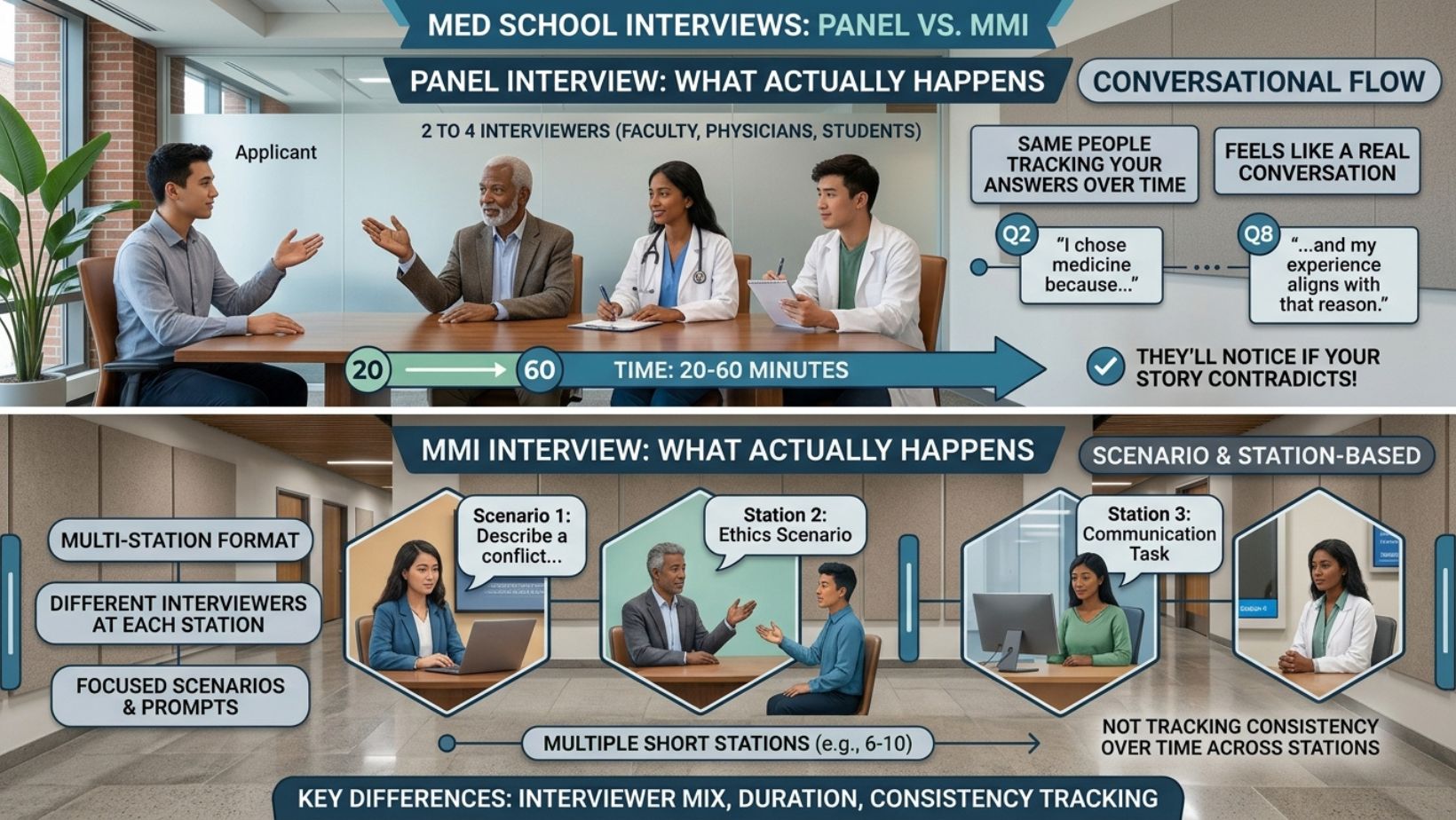
A panel interview puts you in a room with two to four interviewers, often a mix of faculty, physicians, and sometimes current students, for a conversation that can run anywhere from twenty to sixty minutes. It feels more like a real conversation because it is one. The same people are tracking your answers over time, which means they’ll notice if your story about “why medicine” from question two contradicts something you say at question eight.
The MMI flips that entirely, and this is really where the panel vs. MMI comparison starts to matter for how you prepare. You’ll rotate through roughly eight to ten stations, each lasting five to ten minutes, and at every single one you’re meeting a brand new evaluator who knows nothing about what you said two doors down. There’s no cumulative impression being built. Each station is scored independently, which is exactly why the format was designed the way it was, to reduce the impact of one bad rapport match or one interviewer’s personal bias on your overall result.
Understanding panel vs. MMI at this level matters because the two formats are testing genuinely different things, even though they’re both trying to answer the same underlying question about whether you’d make a good physician.
Why the Interview Format Changes Your Communication Style
Here’s where most applicants trip up when it comes to panel vs. MMI prep. They prepare one generic set of answers and assume they can deploy the same version of themselves regardless of format. That works passably in both settings, but it won’t help you stand out in either, which is exactly why the panel vs. MMI distinction deserves real attention before interview season.
In a panel interview, you have room to build a narrative arc, and this is one of the clearest points of contrast in the panel vs. MMI comparison. You can reference something you said ten minutes earlier. You can let a story breathe, pause for effect, and read the room’s body language to adjust your pacing. The skill being tested is sustained, coherent communication with the same audience over time, closer to what you’d need in a long clinical conversation with a patient or a colleague.
In an MMI, that same instinct will hurt you, which is why the panel vs. MMI switch trips up so many well-prepared applicants. If you try to build a slow narrative arc in an eight-minute station, you’ll run out of time before you get to the actual point. The skill being tested is closer to what you’ll need in medical residency, where you meet a new patient, a new nurse, or a new attending every few minutes and have to establish trust, gather information, and communicate clearly, fast, over and over again, all day.
That’s really the heart of panel vs. MMI as a communication challenge. One rewards depth with a stable audience. The other rewards speed and adaptability with a constantly changing one.
Panel vs. MMI: Which Canadian Schools Use Which Format
Formats do shift over time, so always confirm directly with the school before your interview, but here’s the general landscape for panel vs. MMI across the country:
- Panel format: Western, the University of Ottawa, Queen’s, and the University of Saskatchewan.
- MMI format: McMaster, UBC, and Calgary, among others.
- Hybrid or modified formats: The University of Toronto uses a Modified Personal Interview, a genuine cross between panel vs. MMI, with four longer stations. The University of Manitoba runs MMI for most applicant pools but panel interviews for its Canadian Indigenous applicant pool.
If you’re applying broadly across Canada as most pre-med applicants do, there’s a good chance you’ll face both sides of the panel vs. MMI divide in the same admissions cycle, sometimes within the same week. That’s exactly why practicing the switch between them matters more than mastering just one.
Practical Ways to Adapt Between Panel and MMI
Switching gears between formats is a skill you can train for, and treating panel vs. MMI as two separate practice tracks, not one generic interview prep plan, makes the transition far less jarring.
- Rehearse your stories at two lengths. Have a ninety-second version for MMI stations and a fuller three to four minute version with more texture for panel settings.
- Practice cold starts. This is one of the fastest ways to get comfortable with panel vs. MMI switching. MMI success depends on being able to walk into a room and orient yourself to a brand new scenario within the first fifteen seconds. Panel success depends on warming up gradually and building rapport across the full conversation.
- Watch your energy reset. Between MMI stations, you have roughly two minutes to shake off the last station and walk in fresh, a discipline that the panel vs. MMI contrast makes especially clear since panel interviews don’t require the same reset. A weak answer at station three shouldn’t bleed into station four.
- Get outside feedback on both formats separately. A medical student who has already been through interview season can flag habits you can’t see in yourself, and many applicants also work with medical consultants who run mock sessions covering both sides of panel vs. MMI so the transition between them feels less jarring on the actual day.
Ready to Practice Both Formats the Right Way?
Reading about panel vs. MMI only gets you so far. What actually moves the needle is timed, realistic practice in both formats with feedback from people who’ve seen hundreds of applicants go through this exact process. MDconsultants Prep runs mock panel interviews and mock MMI circuits built around what specific Canadian schools actually ask, so whichever side of panel vs. MMI you’re walking into, you show up ready.