If you have ever mapped out your career timeline on a napkin, trying to figure out how many more years stand between you and actually practicing medicine, you have probably typed some version of “shortest residency program in Canada” into Google late at night. It’s a fair question, and the answer matters more than most applicants realize when they’re still years away from CaRMS.
Quick answers, before we get into it:
- What is the shortest residency program in Canada? Family Medicine, at two years, remains the shortest residency program in Canada.
- How long is the longest residency in Canada? Neurosurgery and cardiac surgery sit at the other end, running 6 to 7 years.
- Is Canada’s family medicine residency really shorter than other countries? Yes. Canada’s two year program is shorter than family medicine training in the US, UK, Australia, and most of Europe, which typically run 3 to 5 years.
- Is the shortest residency program in Canada about to get longer? It almost did. The College of Family Physicians of Canada planned to extend it to three years starting in 2027, then reversed course after a members’ vote in late 2025.
Let’s walk through what all of that actually means for you.
So, What Is the Shortest Residency Program in Canada, Exactly?
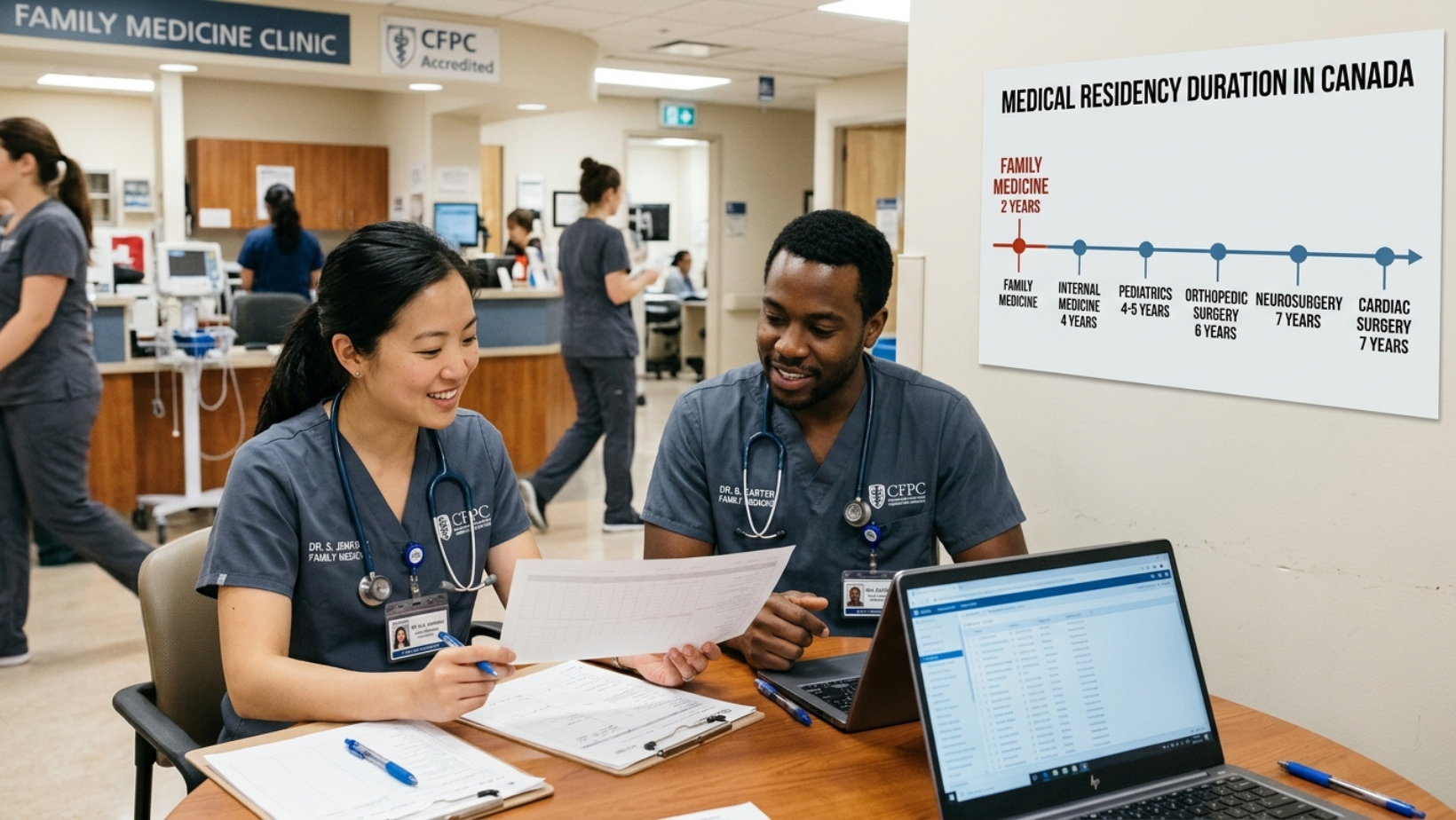
The shortest residency program in Canada is Family Medicine, a two year postgraduate training program accredited by the College of Family Physicians of Canada, or CFPC. Every other Royal College specialty in the country runs longer than this shortest residency program, typically between four and seven years depending on how surgical or subspecialized the field is. Internal medicine and pediatrics usually sit around four to five years, while procedural specialties like orthopedic surgery, neurosurgery, and cardiac surgery stretch out to six or seven.
That two year window makes Family Medicine the shortest residency program in Canada and the fastest route from a medical degree to independent practice in the entire country, and it is one of the reasons the CFPC itself has called it the shortest in the developed world. For comparison, family medicine residents in the US train for three years, and in Australia and parts of Europe it can run four to five.
Here’s the part that trips a lot of applicants up though. “Shortest” does not mean “easiest.” Even the shortest residency program in Canada packs a lot in, since a two year timeline means residents move through obstetrics, pediatrics, emergency medicine, internal medicine, psychiatry, surgery, and community rotations at a fast clip, with far less room to slow down than someone spending five or six years building the same breadth of skill.
Why Applicants Care About the Shortest Residency Program in Canada
If you’re a pre-med applicant weighing specialties years before CaRMS even enters the picture, the pull of the shortest residency program probably matters more than you’d like to admit. Fewer years of resident salary, which typically sits in the $60,000 to $70,000 CAD range, means fewer years of deferred earning, deferred family planning, and deferred everything else life throws at you during your twenties and thirties. It also means less time carrying the mental load that comes with medical residency itself, the long call shifts, the constant evaluation, the pressure to perform.
None of that should be the only reason you choose a specialty. But it is a completely legitimate factor, and pretending the appeal of the shortest residency program doesn’t exist does applicants a disservice. A medical student who is honest about wanting the shortest residency program and a generalist path toward independent practice is not being less committed than one chasing a seven year surgical fellowship. They’re just optimizing for a different life.
Could the Shortest Residency Program in Canada Get Longer Soon?

This is where the story gets interesting, and where a lot of outdated blog posts online are giving you stale information about the shortest residency program in Canada. In 2022, the CFPC announced plans to extend what was then the shortest residency program in Canada, taking Family Medicine from two years to three, aiming to better prepare graduates for increasingly complex patients, new technologies, and team-based care. The rollout was originally slated to begin in 2027.
That plan did not survive contact with the profession. In late 2025, CFPC members voted overwhelmingly, more than 91 percent, to halt the third year rollout entirely, citing fears that a longer program would worsen an already severe family doctor shortage and discourage applicants from choosing the specialty in the first place. The CFPC has since paused implementation and launched an independent review.
Practically speaking, that means as of right now, Family Medicine is still holding its title as the shortest residency program in Canada, still sitting at two years, with no confirmed date for that to change. If you’re planning your own CaRMS strategy around this, it’s worth checking the CFPC’s site periodically rather than trusting any single article, including this one, to stay accurate forever.
What This Means If You’re Deciding Between Specialties
Program length is one input among many, not the whole decision. A few things worth weighing alongside it:
- Lifestyle fit. Family Medicine offers broad scope and flexible practice settings, but it is not “easy,” and a shorter timeline does not mean a lighter workload once you’re practicing.
- Long-term income trajectory. Longer, more specialized residencies often lead to higher earning ceilings, though not always higher career satisfaction.
- Match competitiveness. Choosing the shortest residency program has little to do with how competitive a specialty is to match into. Some short programs are less competitive, others are not.
- Personal timeline. If you’re already applying with CASPer test examples fresh in your mind and thinking hard about total years of independent practice, it’s worth mapping out realistic timelines for two or three specialties you’re genuinely interested in, not just the shortest one on paper.
If you’re still early in the process and haven’t matched to the shortest residency program or any other yet, this is also a good moment to think honestly about how test performance, including your CASPer test, MMI performance, and academic record, factors into which doors stay open. Many applicants lean on medical consultants at this stage precisely because narrowing down a realistic specialty list takes more than a Google search.
Ready to Build a Realistic Residency Strategy?
Whether you’re still choosing a specialty or already prepping your CaRMS application, having a clear-eyed view of program length, competitiveness, and lifestyle tradeoffs matters more than simply chasing the shortest residency program on a chart. MDconsultants Prep works with pre-med applicants and residency hopefuls to build application strategies, from CASPer coaching to CaRMS guidance, tailored to the specialty and timeline that actually fit your goals.