
If you’ve ever tried to explain the NRMP Match to a family member and watched their eyes glaze over by the second sentence, you’re not alone. It’s one of the most consequential processes in medicine, and also one of the most confusing, mostly because almost nobody explains the NRMP Match in plain language. Let’s fix that.
A quick overview, before we get into it:
- What is the NRMP Match? The National Resident Matching Program is the system that pairs medical school graduates with residency programs in the United States, using a computer algorithm rather than direct offers and acceptances.
- How does the NRMP Match algorithm actually work? It’s applicant-proposing, meaning the algorithm tries to place you into your first-choice program first, and only moves to your second choice if that placement doesn’t hold.
- Is the NRMP Match the same as CaRMS? No. CaRMS is Canada’s residency matching system. The NRMP Match is the American equivalent, and some Canadian applicants use both if they’re applying cross-border.
- What happens if I don’t match? You enter SOAP, the Supplemental Offer and Acceptance Program, which fills remaining positions after Match Day results are released.
Now let’s walk through what actually happens behind the scenes, because understanding the mechanics changes how you should build your rank list.
What the NRMP Match Actually Is
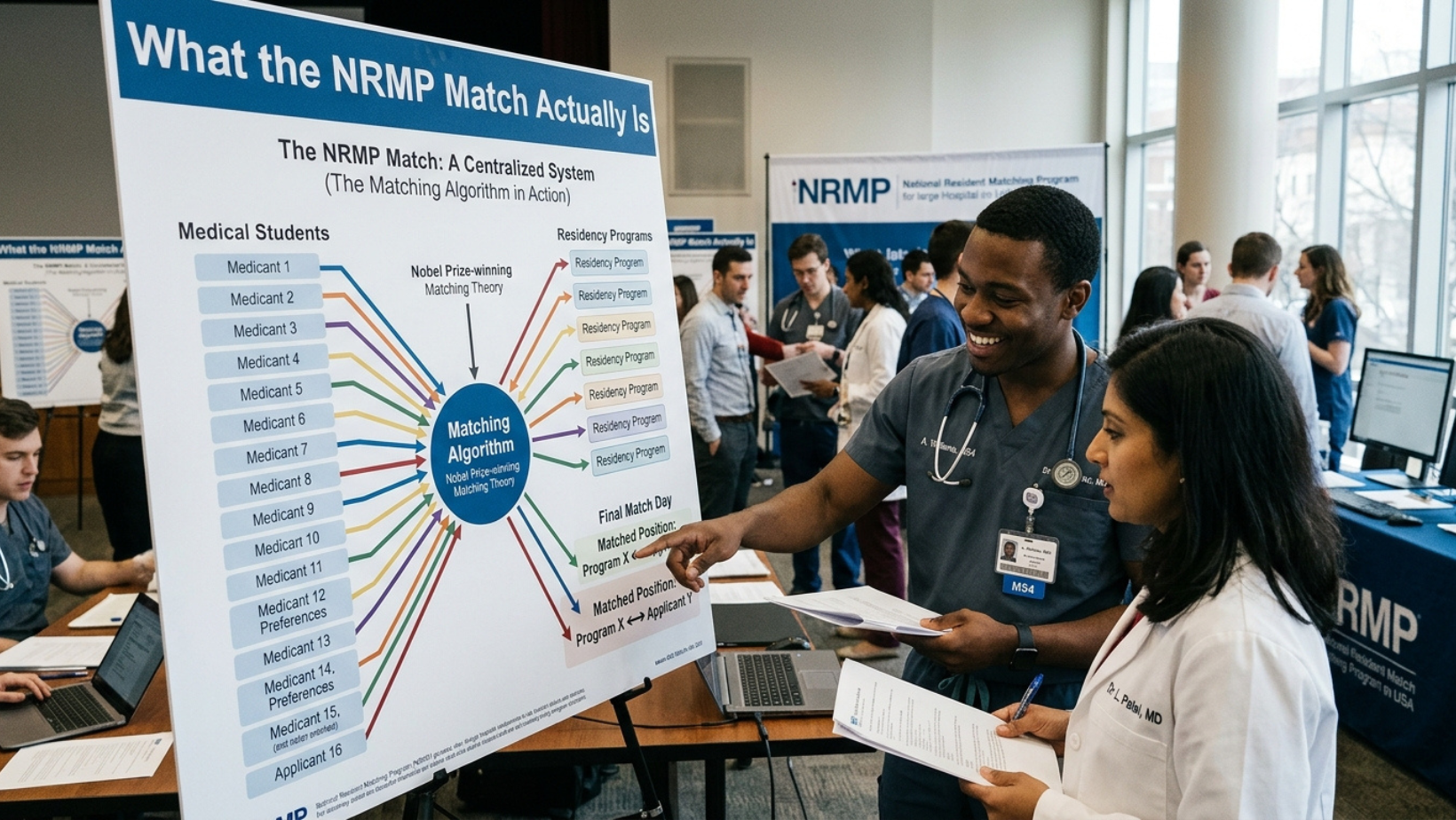
The NRMP Match is a centralized system that pairs applicants with residency programs using a matching algorithm instead of a traditional back-and-forth hiring process. Before the Match existed, hospitals used to compete for top candidates by making earlier and earlier offers, which pressured students into accepting positions before they’d even finished interviewing everywhere. The Match was created to fix that chaos, and the algorithm behind the NRMP Match is based on Nobel Prize-winning matching theory, the same underlying math used in other high-stakes matching systems around the world.
Every applicant creates a Rank Order List, or ROL, ranking every program they interviewed with in true order of preference. Every program does the same thing in reverse, ranking the applicants they’d like to take. Then the NRMP Match algorithm runs both lists against each other simultaneously to produce the best possible outcome for everyone involved, applicants and programs alike.
How the NRMP Match Algorithm Actually Runs

Here’s the part that trips people up, so let’s slow down. The NRMP Match algorithm is applicant-proposing. That means it starts by trying to place you at your number one choice. If that program also ranked you and has room, you get a tentative match there. If the program is full but prefers you over someone else already tentatively matched, that other applicant gets bumped, and the algorithm goes back to their list to try their next choice. This cascading process repeats across every applicant and every program until nobody can be reshuffled anymore, at which point every tentative match becomes final and binding.
The single most important thing to understand about the NRMP Match is this: ranking a reach program first does not hurt you. The algorithm always tries your top choice before considering anything lower on your list, so there’s no strategic advantage to ranking programs based on how likely you think you are to get in. The dominant strategy, confirmed by the NRMP itself, is to rank programs in your genuine order of preference, full stop.
Timeline and Key Dates You Need to Track
The NRMP Match runs on a fixed annual calendar. Registration typically opens in the fall, rank order list entry opens in early February, and the certification deadline usually falls in early March, after which your list locks permanently and cannot be changed. Match Day itself, when results are released, lands in mid to late March. Recent cycles have also introduced smaller pilot changes to the NRMP Match, like the voluntary ROL Lock program in select specialties, so it’s worth checking the NRMP’s own site each year rather than relying on last year’s dates.
For any medical student building a list, the practical takeaway is simple: certify early, but don’t rank a program you wouldn’t actually want to attend just to pad the list. A longer list of realistic, genuinely acceptable programs is safer than a short list of only your dream programs.
Why This Matters More If You’re Applying Across Borders
If you’re a Canadian applicant considering the NRMP Match alongside CaRMS, the two systems run on similar underlying logic, applicant-proposing algorithms and binding rank lists, but they operate on separate timelines with separate registration systems, separate fees, and separate application platforms. Trying to manage both without a clear plan is where a lot of dual applicants lose time; they can’t get back navigating the NRMP Match and CaRMS in parallel. This is exactly the kind of cross-border complexity where medical consultants earn their fee, helping applicants build two coherent strategies instead of one confused one.
Even if you’re not applying cross-border, understanding how the NRMP Match works is worth it earlier than you’d think. A pre-med student who understands how binding rank lists work will make smarter choices about away rotations, letters of recommendation, and specialty exploration years before Match Day ever arrives, because the whole system rewards people who build genuine, well-informed preferences early rather than scrambling to figure them out during interview season.
What to Actually Do With This Information
If you’re currently in medical residency, the Match is behind you, but understanding it still matters if you’re mentoring students below you or considering a fellowship match down the line, since many fellowship matches run on similar NRMP infrastructure. If you’re still building toward your own Match cycle, here’s what actually helps:
- Interview broadly enough that your rank list has real options, not just your top three dream programs.
- Rank in true preference order, since the algorithm rewards honesty, not strategy.
- Track every deadline yourself, since a missed certification date can undo months of work.
- Build a realistic backup plan, including a clear understanding of SOAP, before Match Day arrives.
None of this removes the anxiety of waiting for Match Day. But it does mean you’re making decisions based on how the system actually works, not on rumors passed down from an anxious study group.
Conclusion
The NRMP Match can feel like a black box from the outside, but the mechanics are more transparent than most applicants realize once someone actually walks you through them. It’s an applicant-proposing algorithm that rewards honest rank lists, runs on a fixed and unforgiving calendar, and ultimately exists to protect applicants from the chaotic, pressure-filled hiring process that used to dominate residency placement. Whether you’re years away from your own Match cycle or a resident helping the next class through theirs, understanding how the NRMP Match actually works turns a stressful mystery into something you can plan around.
If you want help building a rank list strategy, navigating a cross-border application, or simply making sense of your options before Match Day, MDconsultants Prep works with applicants at every stage of the process to build a plan grounded in how the system actually works, not guesswork.