If you are applying to medical school in Canada, you have likely already heard that McMaster University’s Michael G. DeGroote School of Medicine is one of the most competitive programs in the country. Understanding the McMaster Medical School Admission Statistics is not just about knowing the numbers. It is about understanding what those numbers mean for your application strategy, where you genuinely stand relative to other applicants, and what it takes to move from applicant to admitted student.
This guide gives you a clear, fact-based breakdown of the most recent McMaster Medical School Admission Statistics, the specific requirements you need to meet, and how the admissions process actually works.
What the Numbers Tell You: McMaster Medical School Admission Statistics
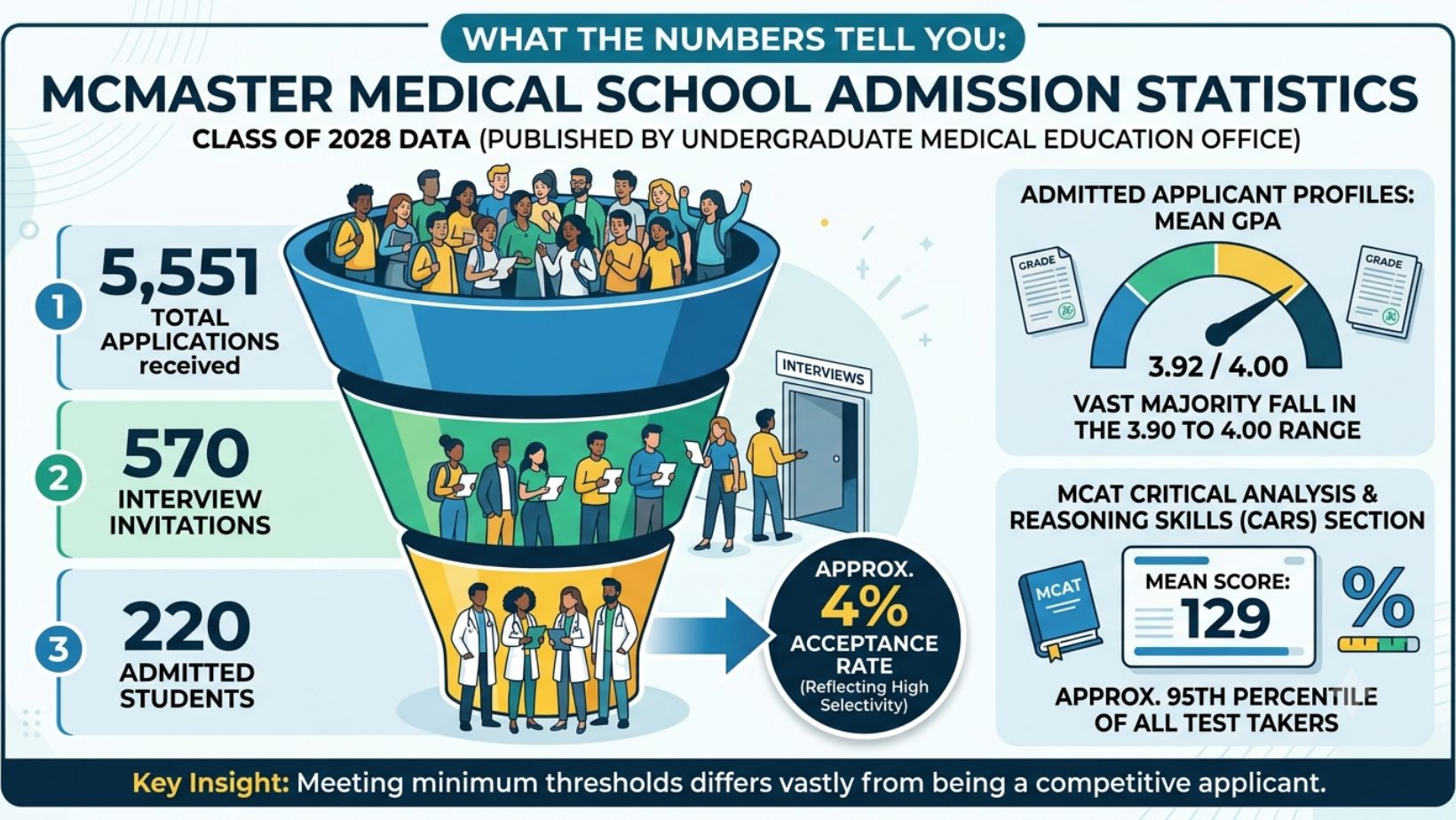
Let us start with the data that matters most. According to the Class of 2028 admission statistics published by McMaster’s Undergraduate Medical Education office, the program received 5,551 applications for one entry cycle. Of those, 570 applicants were invited to interview, and only 220 were ultimately admitted into the program. That gives you an approximate acceptance rate of around 4 percent when measured against the total applicant pool, which reflects just how selective this program is.
Looking at academic profiles among those admitted, the mean GPA was 3.92 out of 4.00, with the vast majority of admitted students falling in the 3.90 to 4.00 range. On the MCAT Critical Analysis and Reasoning Skills section, the mean score was 129, which sits at approximately the 95th percentile of all test takers. These McMaster Medical School Admission Statistics make clear that meeting the minimum thresholds is very different from being a competitive applicant.
Understanding the Minimum vs. Competitive Benchmarks
One of the most important distinctions you need to understand when reviewing McMaster Medical School Admission Statistics is the difference between the minimum requirements for eligibility and the benchmarks that actually give you a realistic chance of receiving an interview invitation.
The minimum GPA to apply is 3.00 on the OMSAS 4.00 scale. The minimum MCAT CARS score required for consideration is 123. However, if you look at the Class of 2028 statistics, only 2 admitted students had a GPA between 3.00 and 3.49, and only 1 admitted student had a MCAT CARS score below 126. In practical terms, you need a GPA above 3.85 and a MCAT CARS score of 128 or higher to be realistically competitive.
Medical School Admission Requirements Specific to McMaster
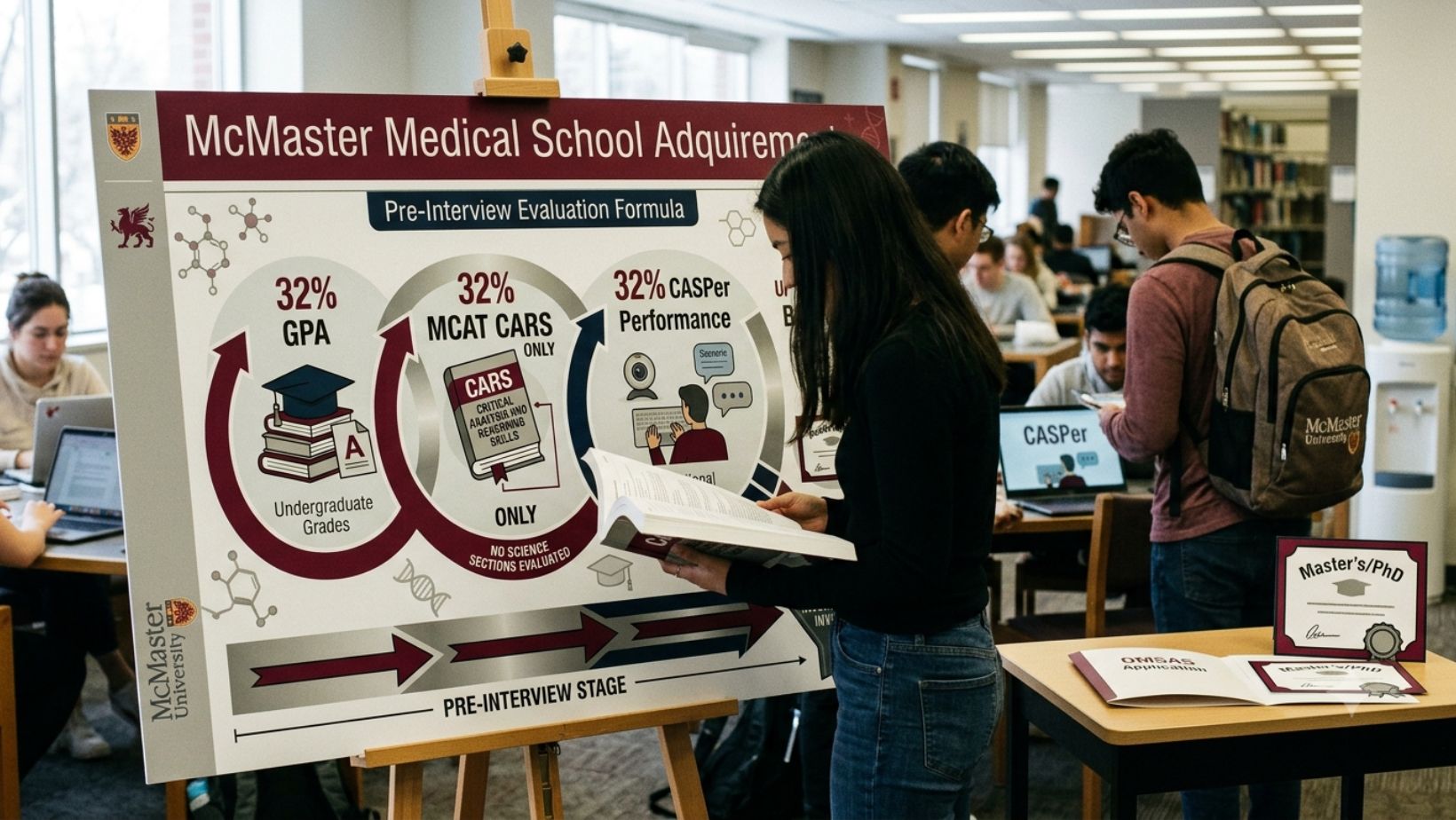
McMaster has several features that make its medical school admission requirements distinct from other Canadian schools. First, unlike most Canadian medical programs, McMaster does not evaluate all four sections of the MCAT. Only the Critical Analysis and Reasoning Skills section is considered, and this score carries equal weight to your GPA and your CASPer performance at the pre-interview stage.
Applications are submitted through the Ontario Medical School Application Service (OMSAS), and the pre-interview selection formula weights GPA at 32 percent, MCAT CARS at 32 percent, and CASPer performance at 32 percent, with a bonus of up to 4 percent available for graduate degree holders. There are no personal statement or supplementary essay requirements at McMaster, which means that your CASPer score is the primary non-academic metric the admissions committee can review before inviting you to interview.
McMaster also does not require any prerequisite courses, which makes it unique among Canadian medical schools. You do not need to have a science background, though most applicants do. At minimum, you need to have completed at least three years of undergraduate study by the time you begin the program.
CASPer: Why It Matters More at McMaster Than Anywhere Else
McMaster is the institution that developed the CASPer test, and they take it seriously. CASPer is an online situational judgment test that presents applicants with scenario-based questions designed to assess non-cognitive qualities such as empathy, ethical reasoning, professionalism, and collaboration. These are traits that GPA and MCAT scores simply cannot measure.
At McMaster, your CASPer score carries as much weight as your academic record at the pre-interview stage. A strong academic profile will not compensate for a weak CASPer performance, and vice versa. This means you need to prepare for CASPer with the same level of intentionality that you bring to MCAT preparation.
The Interview Process and Post-Interview Formula
If your pre-interview score is competitive enough to earn you one of approximately 570 interview spots, you will be invited to complete a Multiple Mini Interview (MMI). McMaster pioneered this interview format, which has since been adopted by medical schools worldwide.
The MMI consists of ten stations, eight of which are assessed and two of which are rest stations. At the post-interview stage, the selection formula shifts significantly: your MMI score accounts for 70 percent of the final decision, with GPA and MCAT CARS each contributing 15 percent. This weighting reflects McMaster’s belief that interpersonal and communication skills are at least as important as academic achievement in determining a physician’s ultimate effectiveness.
Admission Requirements for Medical Schools in Canada: How McMaster Compares
When you look at the broader landscape of admission requirements for medical schools in Canada, McMaster stands out for several reasons. Most Canadian medical schools require all four MCAT sections, weigh personal statements or supplementary applications, and place varying emphasis on extracurricular involvement. McMaster does none of these in the traditional sense.
At the same time, McMaster is one of only two three-year medical programs in Canada, which means the pace of training is accelerated compared to the more common four-year format. This design reflects McMaster’s broader educational philosophy, which has always centered on self-directed, problem-based learning rather than traditional lecture-based instruction. This history of innovation in medical education contributes to the school’s enduring reputation and the competitive nature of its applicant pool.
Geographic Distribution and Class Composition
The Class of 2028 data reveals that 203 of 220 admitted students were from Ontario, 15 from elsewhere in Canada, and 2 from other countries. This geographic distribution is consistent with previous years and reflects the program’s primary commitment to training physicians for Ontario’s healthcare system. McMaster currently does not accept international applicants to the MD program.
In terms of academic background, the most common undergraduate field among admitted students was Biomedical and Health Sciences, with 88 admitted students from that background. However, the class also included students from Engineering, Life Sciences, Arts and Humanities, and Social Sciences, which reflects the program’s openness to applicants from diverse academic backgrounds.
What You Can Do With This Information
The McMaster Medical School Admission Statistics are most useful when you treat them as a calibration tool rather than a source of anxiety. If your current GPA is 3.75 and your MCAT CARS score is 127, you are in a realistic but not guaranteed range. If your GPA is 3.92 and your MCAT CARS score is 130, you are academically competitive, but you still need a strong CASPer score and an effective MMI performance to receive an offer.
The most important takeaway from reviewing these statistics is that McMaster’s admissions process is genuinely multi-dimensional. No single metric will get you in, and no single weakness will necessarily keep you out, as long as your overall profile is competitive and your non-academic skills are genuinely strong.
Final Thoughts
The McMaster Medical School Admission Statistics paint a clear picture of one of Canada’s most selective and innovative medical programs. With a mean admitted GPA of 3.92, a mean MCAT CARS score of 129, and an overall acceptance rate of approximately 4 percent, the competition is real. But so is the opportunity for applicants who prepare thoughtfully, understand what McMaster is actually looking for, and approach both their academic record and their CASPer and MMI preparation with equal seriousness.
If you want expert guidance on building a competitive application and navigating every stage of the process, MDconsultants Prep offers dedicated support to help you move forward with clarity and confidence.