To prepare for residency interviews in 2027, know your dates and format, build a personal story, practice common questions out loud, research each program, set up your virtual space and plan your follow up. Canadian residency interviews often use the Multiple Mini Interview (MMI) or a panel format, and recent cycles have been conducted virtually, so your preparation should cover both your answers and your delivery.
Feeling the pressure? You’re not alone. Here are the questions people keep typing into Google, and we’re answering every one:
- How do I prepare for a residency interview?
- What are common residency interview questions?
- Are residency interviews virtual?
- What should I ask during a residency interview?
- Should I send a thank you note after a residency interview?
The 2027 CaRMS Timeline: Know Your Dates
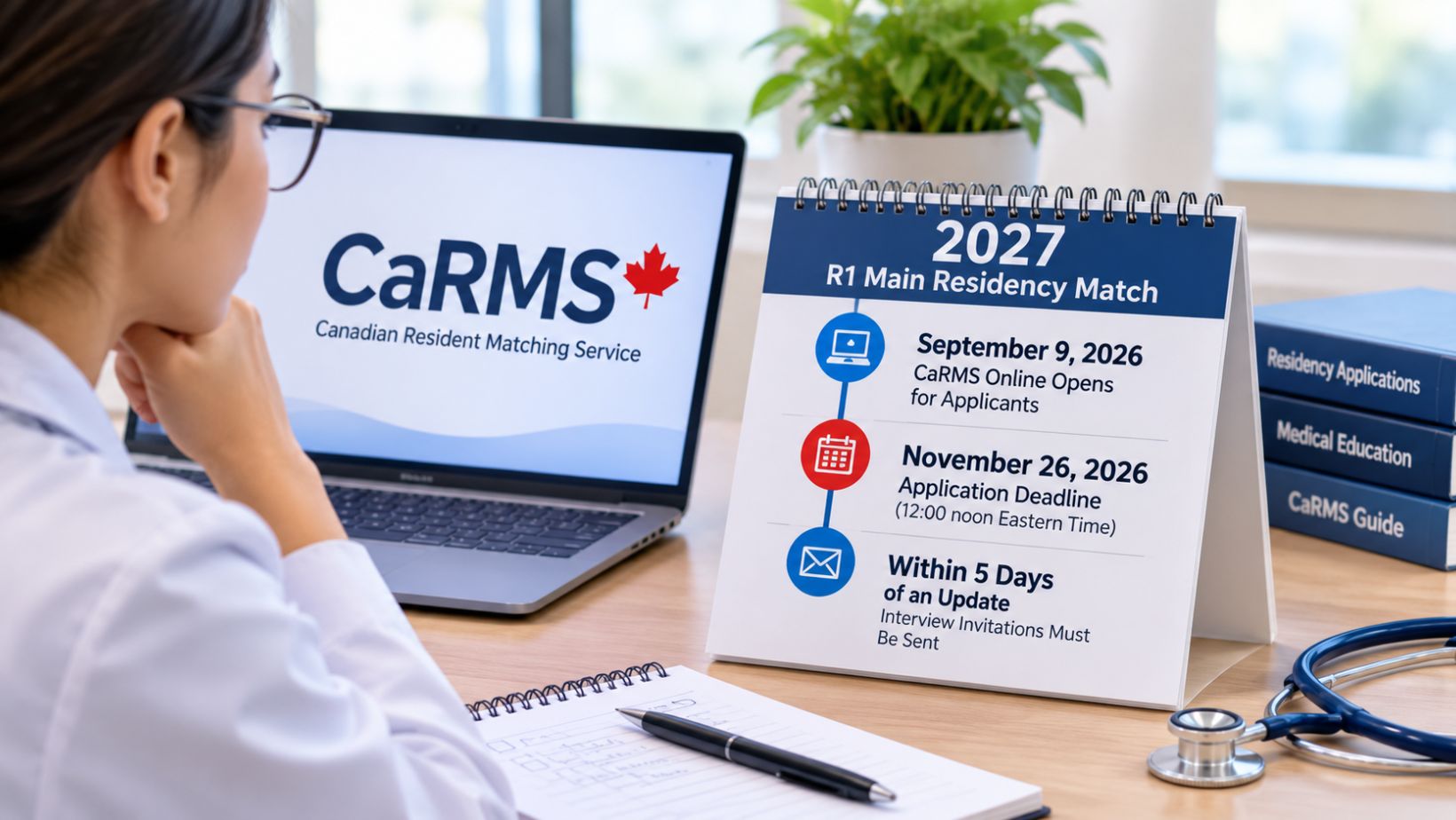
Start with the calendar, because everything else hangs on it. For the 2027 R1 Main Residency Match, CaRMS Online opened for applicants on September 9, 2026, and the application deadline is November 26, 2026 at noon Eastern Time, when file review begins. Programs then update interview offer statuses, and official invitations must go out within five days of an update.
For current year Canadian medical graduates from out of town universities, the national interview period runs from January 16 to February 7, 2027. Interviews for international medical graduates and for applicants at their own schools are coordinated separately, with no national interview period. Match Day is March 2, 2027 at noon Eastern Time.
One smart move from a Canadian medical school guide: build a calendar of when each program releases interview offers so you know when to accept. Dates can change, so check the official CaRMS applicant timeline regularly.
Know Your Format: MMI, Panel and Virtual
The MMI is the most widely used residency interview format in Canada. Expect 6 to 10 stations of about 8 minutes each, with a different interviewer at each station and a short reading period in between. Panel interviews usually involve program directors, faculty and senior residents asking structured or semi structured questions over 20 to 45 minutes.
In the 2026 match, all Canadian postgraduate interviews were conducted virtually, and that format is expected to continue. Confirm the format with each program, and prepare for video either way.
| Format | What to expect | How to prepare |
| MMI | Timed stations with different interviewers and scenarios | Practice thinking out loud and structuring answers quickly |
| Panel | Several interviewers, 20 to 45 minutes, personal and program questions | Prepare your story and program specific reasons |
| Virtual | Live video interview, often with MMI or panel content | Test technology, lighting and sound well ahead of time |
Step 1: Know Your Story
Before you practice anything, get clear on who you are. Review your application so nothing in it surprises you, then prepare a personal narrative that explains your background, your path to this specialty and what you want to contribute.
Canadian programs assess your answers against the CanMEDS roles, so one practical tip from a medical school interview guide is to prepare a clinical story and a nonclinical story for each role. A question about a conflict with a colleague, for example, is really testing collaboration and professionalism.
Step 2: Practice Out Loud

Reading answers in your head isn’t practice. Say them out loud, with a friend, mentor, career advisor or your school’s mock interview program. Queen’s University’s career tipsheet recommends practising with family, friends or a coach, and preparing for questions about career motivation, patient empathy and resilience.
Prepare for the classics:
- Tell me about yourself.
- Why this specialty?
- Why this program?
- What can you contribute to our residency?
- Describe a mistake you made and what you learned.
A good rule of thumb from one Canadian mock interview guide is to prepare three or four specific reasons you’d contribute, tied to what the program values, instead of repeating your strengths.
Step 3: Research Each Program
Generic answers don’t win interviews. Read each program description on CaRMS, look at its selection criteria and note what makes it different: structure, research, further training and culture.
Then prepare your own questions. Good ones cover program structure, further training opportunities, research opportunities and opportunities to learn specific skills. Interviews are also your chance to see whether the program fits you.
Step 4: Nail the Virtual Setup
A virtual interview is a real interview. Log in early, and test your camera, microphone, lighting and background in advance. Look at the camera when you speak, keep your posture professional and dress as you would in person. Practice on the same device and internet connection you’ll use on the day, and have a backup plan if something fails.
Step 5: Know the Rules
CaRMS publishes interview guidelines, including guidance on inappropriate questions. Read them before interview season, so you know what programs should and shouldn’t ask and can respond calmly if something crosses a line.
After the Interview: Reflect and Follow Up
Write down the questions you were asked and how you felt about your answers. Queen’s tipsheet suggests reviewing which questions were challenging, and one medical school guide recommends revisiting your reflections before you submit your rank order list.
Thank you notes are more common for residency interviews than for medical school interviews. Keep yours short and focused on gratitude, not on listing your qualities again.
Get Support From MDconsultants Prep
You don’t have to do this alone. MDconsultants Prep supports aspiring and current doctors with guidance built for the Canadian pathway. If you’re in training, explore our resources for medical students. If you’re earlier in the journey, our premed pages can help you plan ahead. Curious how it works in practice? Read what others have said on our testimonials page.
Frequently Asked Questions
How do I prepare for a residency interview?
Know your dates and format, build your personal story, practice common questions out loud, research each program and set up your virtual space.
Are residency interviews virtual in Canada?
All Canadian postgraduate interviews in the 2026 match were virtual, and the format is expected to continue. Check each program’s instructions.
What is the MMI format?
It’s a set of timed stations, usually 6 to 10 of about 8 minutes each, where you respond to different scenarios with a different interviewer at each station.
What should I ask during a residency interview?
Ask about program structure, further training opportunities, research opportunities and ways to build specific skills.
Should I send a thank you note after a residency interview?
It’s common for residency interviews and often appreciated. Keep it brief and focus on thanking the interviewers.
Conclusion
So, how to prepare for residency interviews 2027? Learn the CaRMS timeline, know your format, shape your story, practice out loud, research every program and polish your virtual presence. Preparation turns nerves into confidence, and confidence is what interviewers remember.
Ready to take the next step? Join MDconsultants Prep or contact our team to talk about your goals.